One Bible.
One Story.
One Covenant.
Rediscovering the biblical foundation of Christian faith—and the continuous story of redemption from Abraham to Jesus Christ.
The Bible is not two disconnected stories.
For generations, many Christians have approached Scripture as though the Old Testament belongs to Israel and the past, while the New Testament belongs to Christians and the Church.
But when Scripture is viewed as a whole, another picture emerges.
God's plan of redemption unfolds as one continuous covenantal story—beginning with Abraham, continuing through Isaac and Jacob, whom God renamed Israel, and ultimately finding its fulfillment in Jesus Christ.
Jesus did not arrive to begin an unrelated story. He came within the story God had already been revealing.
The Law, the Prophets, the Writings, the teachings of Jesus, and the writings of the apostles are not competing revelations. When their biblical connections are restored, what may once have appeared fragmented begins to reveal one unified story of redemption.
“And if ye be Christ's, then are ye Abraham's seed, and heirs according to the promise.” — Galatians 3:29
The Feasts and the Lord of the Feasts
The feasts are not disconnected from Jesus.
Many Christians hear words such as Passover, Unleavened Bread, Firstfruits, Pentecost, Trumpets, Atonement, and Tabernacles and immediately associate them exclusively with Judaism.
Yet God calls them “the feasts of the LORD” and “my feasts” (Leviticus 23:2).
One Covenant asks the reader to look again. The book traces a pattern through these appointed times and argues that they reveal important aspects of God's redemptive plan in Jesus Christ.
Read It Before You Disagree With It.
I am not asking you to agree with One Covenant before you read it.
I am asking you to do something much simpler: read it before you disagree with it.
One Covenant raises questions that may challenge long-held traditions, denominational teachings, and familiar interpretations of Scripture. That is intentional.
The purpose is not to tell you what you must believe. The purpose is to place the biblical evidence before you and invite you to examine it for yourself.
- Examine every Scripture.
- Challenge every argument.
- Question every conclusion.
- Test what is written against the Word of God.
If an argument cannot withstand biblical examination, it should not be accepted simply because it appears in this book. But the opposite is equally important.
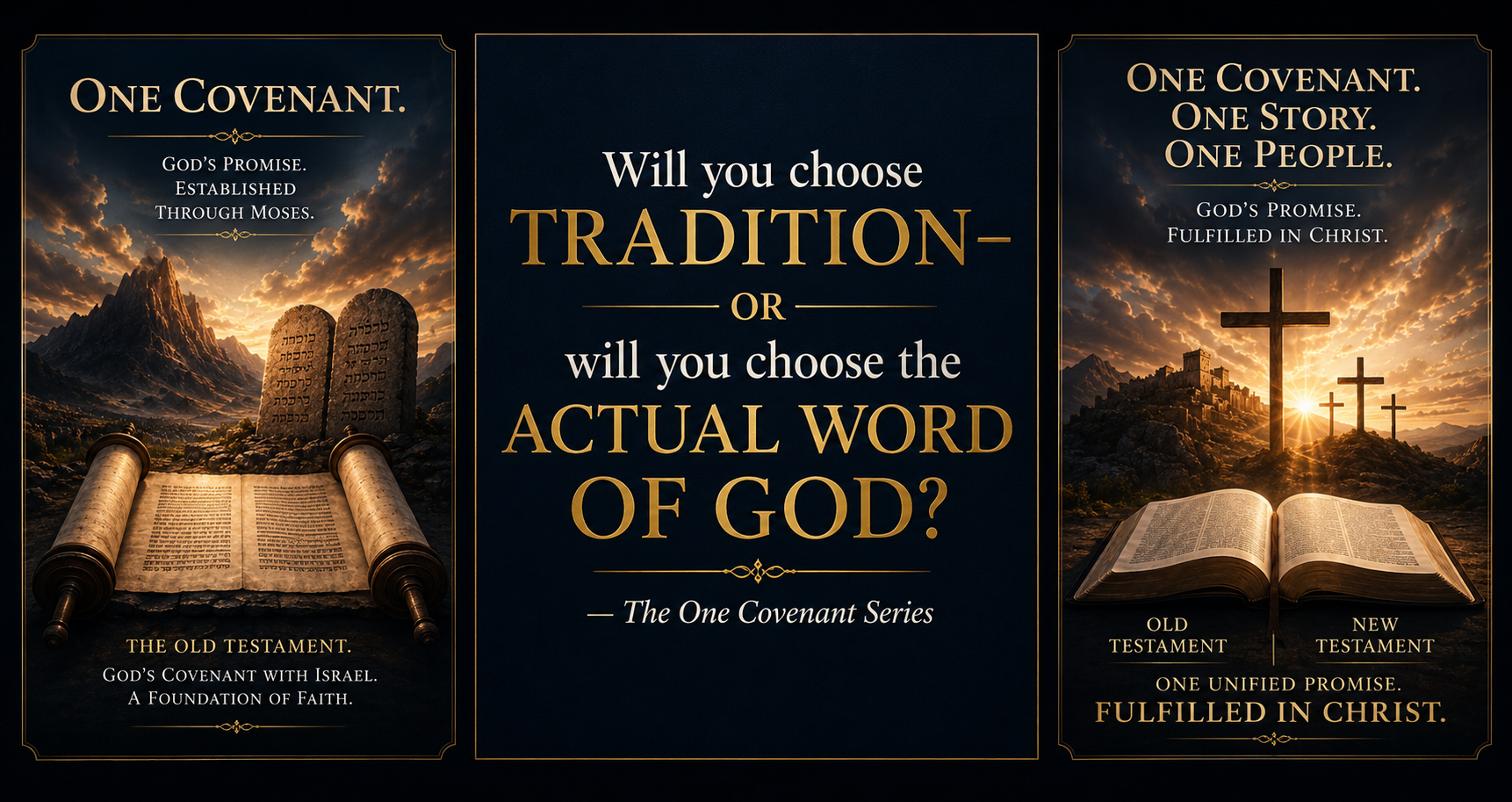
One Covenant is not an invitation to blind agreement. It is an invitation to investigation—to compare Scripture with Scripture and allow the Bible to speak before tradition answers for it.
Read it. Examine it. Search the Scriptures for yourself.
Explore the book, the Bible Questions & Answers Series, and more teaching at One Covenant.
Explore One Covenantwww.onecovenant.org